
Top 5 Yoga Practices to Relieve Back Pain
Top 5 Yoga Practices to Relieve Back Pain
Back pain is one of the most common reasons people try yoga. The right movements can ease stiffness, build the muscles that support your spine, and teach you to move without bracing. The wrong ones, done too deep or too fast, can make things worse.
This guide covers five gentle, widely used practices, how to do each one safely, what the research says, and when to stop and see a doctor instead.
Before You Begin
These practices are meant for general, non-specific back pain, such as stiffness from sitting or mild muscular aches. They are not a treatment for every kind of back problem.
See a doctor before starting, and do not practice, if you have:
- Numbness, tingling, or weakness in the legs
- Pain that shoots down the leg
- Loss of bladder or bowel control
- Back pain after a fall or accident
- Fever with back pain, or unexplained weight loss
- Severe pain that wakes you at night or does not ease with rest
- A diagnosed disc herniation, fracture, or spinal condition (ask your doctor which movements are safe)
General rules:
- Move slowly and stop at the first sign of sharp pain. Mild stretching is fine; pain is not.
- Never force a pose or bounce.
- Warm up with a few minutes of gentle walking or joint rolls.
- Breathe steadily and do not hold your breath.
- Practice on a mat, on a flat floor, with loose clothing.
1. Marjaryasana-Bitilasana (Cat-Cow)
Why it helps: It gently moves the whole spine through flexion and extension, which eases stiffness and builds awareness of how your back moves.
How to do it:
- Start on hands and knees, wrists under shoulders, knees under hips.
- Inhale, let the belly drop, lift the chest and tailbone slightly (Cow).
- Exhale, round the back toward the ceiling, tuck the chin and tailbone (Cat).
- Move slowly, matching each movement to your breath.
- Repeat 8 to 10 times.
Tip: Keep the movement small if your back is sore. It is a warm-up, not a deep stretch.
2. Balasana (Child’s Pose)
Why it helps: It gently lengthens the lower back and hips and encourages relaxation.
How to do it:
- Kneel on the mat, big toes touching, knees hip-width apart or wider.
- Sit back toward your heels and fold forward, arms extended in front or resting by your sides.
- Rest your forehead on the mat or a cushion.
- Breathe slowly into the back of the ribs for 30 to 60 seconds.
Tip: If sitting back hurts your knees or hips, place a folded blanket between your thighs and calves, or rest your torso on a bolster or pillow.
3. Sphinx Pose or Gentle Bhujangasana (Cobra)
Why it helps: A mild backbend strengthens the muscles along the spine and can ease stiffness from sitting.
How to do it (Sphinx, the gentler version):
- Lie on your stomach, legs extended, tops of feet on the mat.
- Place forearms on the floor, elbows under shoulders.
- Press lightly through the forearms, lift the chest, and keep the shoulders relaxed.
- Keep the neck long and the glutes soft.
- Hold for 20 to 30 seconds, then lower. Repeat 3 times.
Tip: Skip this pose if it increases your pain or causes pinching in the lower back. Some people find backbends uncomfortable, and that is a reason to stop, not to push harder.
4. Supta Matsyendrasana (Supine Twist)
Why it helps: A gentle lying twist releases tension in the lower back and hips without loading the spine.
How to do it:
- Lie on your back with knees bent, feet on the floor.
- Draw both knees toward the chest, then let them fall slowly to one side.
- Extend arms out to the sides, shoulders staying on the floor.
- Turn your head to the opposite side if comfortable.
- Hold for 30 to 45 seconds, breathing slowly, then switch sides.
Tip: Place a pillow under the knees if they do not reach the floor. Keep the twist gentle and skip it if it causes sharp or shooting pain.
5. Setu Bandhasana (Bridge Pose)
Why it helps: It strengthens the glutes, hamstrings, and the muscles supporting the lower back, which share the load your spine would otherwise carry.
How to do it:
- Lie on your back, knees bent, feet hip-width apart and close to the hips.
- Press through the feet and lift the hips until the body forms a line from shoulders to knees.
- Keep the knees pointing forward and the neck relaxed.
- Hold for 15 to 30 seconds, then lower slowly.
- Repeat 5 to 8 times.
Tip: Lift only as high as feels comfortable. Squeeze the glutes rather than overarching the lower back.
A Simple 15-Minute Routine
- Cat-Cow: 1 minute
- Child’s Pose: 1 minute
- Sphinx Pose: 3 rounds of 20 seconds
- Bridge Pose: 5 to 8 repetitions
- Supine Twist: 45 seconds per side
- Rest on your back, knees bent, for 2 to 3 minutes
Practice once a day, or at least 4 to 5 days a week. Short, regular sessions work better than occasional long ones.
Common Mistakes
Pushing through pain. Mild stretch is fine. Sharp, shooting, or increasing pain means stop.
Going too deep too soon. Deep forward folds, strong backbends, and deep twists can aggravate some back problems.
Holding the breath. It increases tension. Breathe slowly throughout.
Skipping strength work. Stretching alone is not enough. Bridge pose and gentle core work help support the spine.
Ignoring daily habits. Long sitting, poor posture, and lack of walking can undo a good practice. Stand and move every 30 to 45 minutes.
Expecting overnight results. Back pain usually improves gradually over weeks.
Personal Yoga Classes at Home for Back Pain
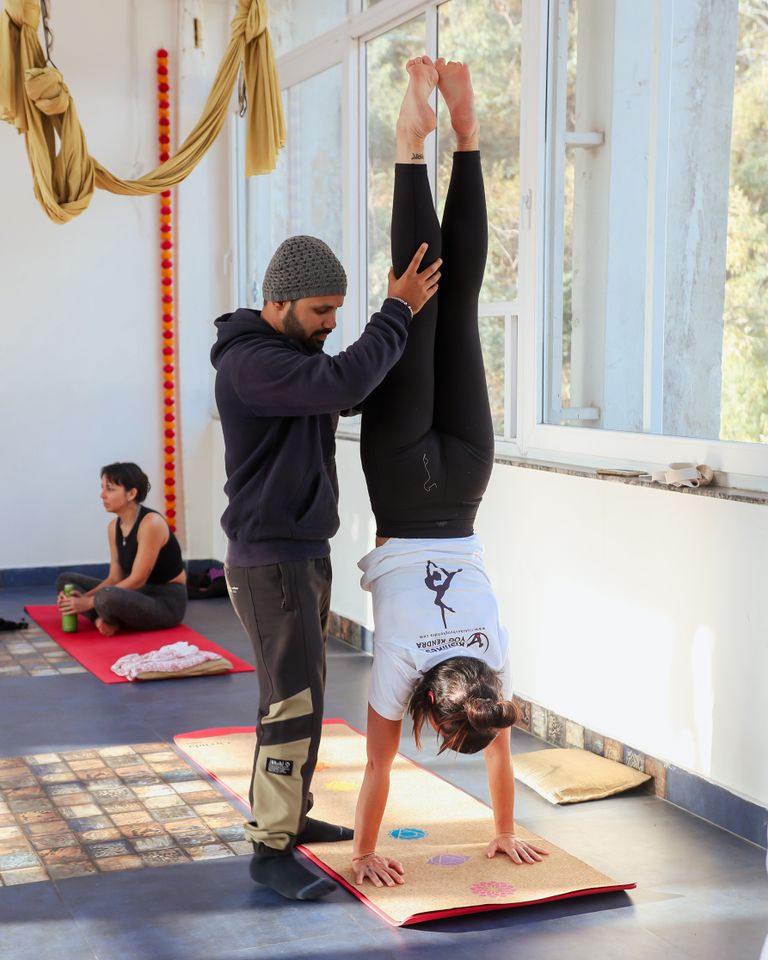
Back pain is one of the conditions where individual guidance matters most. A pose that relieves one person’s stiffness can aggravate another’s, depending on the cause, the posture, and how the body moves. A trainer at home can watch how you bend, twist, and lift, correct small alignment mistakes before they cause strain, and adjust every pose with props, shorter holds, or alternatives so you practice within your comfort zone.
A personal class also lets you set the pace, timing, and focus around your needs, and a good instructor will ask about your health history before the first pose. They can give you a short routine to repeat between sessions, which is what makes regular practice possible. Tell your instructor about the location and nature of your pain, any diagnosis, and anything that makes it worse, and check with your doctor first if your pain is severe, recurring, or comes with leg symptoms. A personal class does not replace medical care, but it makes safe, consistent practice much easier.
What Does the Research Say?
Yoga has been studied for back pain more than for most other conditions, and the findings are modest and more nuanced than popular claims suggest. Here is what the evidence shows, with links to the sources.
1. Yoga helps a little, and carries some risk of aggravating pain. A Cochrane systematic review of yoga for chronic non-specific low back pain found low- to moderate-certainty evidence that yoga, compared with no exercise, results in small and clinically unimportant improvements in back-related function and pain. It also found low-certainty evidence from eight trials that yoga increased the risk of adverse events, primarily increased back pain, at six to 12 months. In other words, yoga is not a cure, and it can aggravate pain in some people.
Source: Yoga for chronic non-specific low back pain (Cochrane Database of Systematic Reviews, 2022, PubMed)
2. Who teaches and what is taught seems to matter. In Cochrane’s plain-language summary of the same review, the authors note that in every study reviewed, the yoga exercises were developed to treat low back pain and the classes were led by experienced practitioners. They also say yoga is probably better than no exercise for pain and function after three months, though the improvements are small, and that back pain was the most common harm reported. This supports choosing a qualified instructor and a program designed for back pain rather than a generic fitness class.
Source: Yoga may have health benefits for people with chronic non-specific lower back pain (Cochrane)
3. Yoga has also been compared head-to-head with physical therapy exercise. A meta-analysis of 18 randomized controlled trials compared yoga with non-exercise controls and with physical therapy exercise on pain, disability, and quality of life in chronic low back pain, searching databases up to November 2019. I could only confirm its design from the available summary, not its numerical results, so check the full paper before quoting specific figures.
Source: Yoga compared to non-exercise or physical therapy exercise on pain, disability, and quality of life for patients with chronic low back pain (PLOS ONE)
How to Read This Research
The overall picture is that yoga is a reasonable, low-cost option for chronic non-specific back pain, with small average benefits and a real chance of temporary soreness. The best results seem to come from programs designed for back pain and taught by experienced instructors. These findings apply to chronic non-specific pain, not to nerve pain, disc injuries, or acute injuries.
The Bottom Line
Gentle, well-chosen yoga can ease stiffness, build the muscles that support your spine, and help you move with more confidence. It will not fix every kind of back pain, and the research shows only modest average benefits.
Start slowly, stay within a pain-free range, choose a qualified instructor, and see a doctor if your pain is severe, spreading, or accompanied by numbness or weakness.