
Bhramari Pranayama
Bhramari Pranayama: How to Practice Humming Bee Breath, Its Benefits, and Research
Most breathing practices ask you to focus on air. Bhramari asks you to focus on sound. By turning the exhale into a steady hum, it gives a restless mind something to follow, and the vibration is something you can feel in your face and skull. That is a big part of why it works so well for beginners and stressed minds.
This guide covers what Bhramari is, how to do it step by step, what the research says, and the precautions worth knowing.
What Is Bhramari Pranayama?
Bhramari comes from bhramara, the Sanskrit word for a black Indian bee. The name points to the hum you make while breathing out, which resembles a bee’s buzz.
Traditional texts describe a version in which you inhale quickly with a sound like a male bee and exhale slowly with a sound like a female bee. The modern, widely taught version is gentler: a smooth inhale through the nose, then a long exhale with a low, steady hum and the mouth closed.
Bhramari vs. Anulom Vilom vs. Kapalbhati
All three are popular, but they feel very different.
- Kapalbhati: sharp, forceful exhales. Energizing.
- Anulom Vilom: slow alternate nostril breathing. Balancing.
- Bhramari: smooth breathing with a humming exhale. Soothing.
A common order is Kapalbhati to wake up, Anulom Vilom to steady the breath, and Bhramari to finish with a calm mind.
Potential Benefits
Be skeptical of claims that Bhramari cures hypertension, depression, or migraines. The realistic list is shorter, but still useful.
1. A quicker way to calm down. The long exhale and the sound give the mind one simple task. Many people feel the mental noise drop within a few rounds.
2. A good tool for stressful moments. Because it is silent to outsiders if done softly and needs no equipment, you can use a few rounds before a meeting, exam, or difficult conversation.
3. Better focus before work or meditation. The sound and vibration pull attention inward, which makes sitting quietly afterward easier.
4. Support for easier breathing. Slow, controlled exhaling trains breath control. It is not a treatment for any lung condition.
5. Help winding down at night. A few gentle rounds before bed can signal the body to slow down. Do not expect it to cure chronic insomnia.
6. Awareness of vibration and sound. Many people find the physical sensation of humming grounding in itself.
What Does the Research Say?
Bhramari has been studied for stress, lung function, sinus symptoms, and attention. Most studies are small and short-term. Here is what the evidence shows, with links to the sources.
1. A literature review confirms it is widely researched. One comprehensive review describes Bhramari as a popular, widely practiced, and researched pranayama, and searched Scopus, PubMed, Cochrane Library, and Google Scholar for studies on its health effects.
Source: Exploring the health benefits of bhramari pranayama: A comprehensive literature review (IJPP)
2. Humming showed a low stress index in a pilot study. In a pilot study of 23 participants using long-term heart rate monitoring, humming produced the lowest stress index compared with physical activity, emotional stress, and sleep. The authors concluded that simple Bhramari could be an effective stress buster, though this was a small pilot study.
Source: Humming (Simple Bhramari Pranayama) as a Stress Buster: A Holter-Based Study (Cureus, PubMed)
3. It may help with chronic sinus symptoms alongside regular treatment. In a study of patients with chronic rhinosinusitis, one group received conventional treatment only, while another group of 30 received the same treatment plus daily Bhramari. The authors concluded that adding Bhramari to conventional management was more effective than conventional management alone. It was an add-on, not a replacement for medical care.
Source: The Efficacy of Yogic Breathing Exercise Bhramari Pranayama in Relieving Symptoms of Chronic Rhinosinusitis (PMC)
4. It may improve lung function in healthy people. A prospective randomized controlled trial tested Bhramari and OM chanting on pulmonary function in healthy individuals and concluded that both were effective in improving it.
Source: Effect of Bhramari pranayama and OM chanting on pulmonary function in healthy individuals (PMC)
5. Researchers have tested its effect on attention control. A study of male students at a yoga university examined how Bhramari affects response inhibition on a stop signal task. In the control session, participants took the same posture without producing the humming sound.
Source: Effect of Bhramari Pranayama on response inhibition: Evidence from the stop signal task (PMC)
6. Sleep research is still underway. A registered randomized trial plans to compare Bhramari with Simha (lion’s breath) pranayama in 68 healthy adults, assessing sleep and quality of life. Results are not yet available, so treat sleep claims as unproven.
Source: Simha Pranayama and Bhramari Pranayama Relaxation Technique on Sleep and Quality of Life (ClinicalTrials.gov)
How to Read This Research
The studies are mostly small, short, and done on healthy adults. They suggest Bhramari is a low-risk practice with plausible calming and respiratory benefits, but they do not prove it treats any disease. Use it as a daily habit, not a replacement for medical care.
Before You Begin
- Light or empty stomach. Wait 2 to 3 hours after a meal.
- Quiet space. Since sound is the point, a quiet room helps you notice the hum.
- Comfortable seat. Sit in Sukhasana, Padmasana, or Vajrasana, or on a chair with feet flat.
- Clean hands and trimmed nails, since your fingers will rest near your face.
- Relaxed jaw. Keep your lips closed and teeth slightly apart.
Step-by-Step Technique
- Sit tall with a straight spine and relaxed shoulders. Close your eyes.
- Take two or three normal breaths to settle.
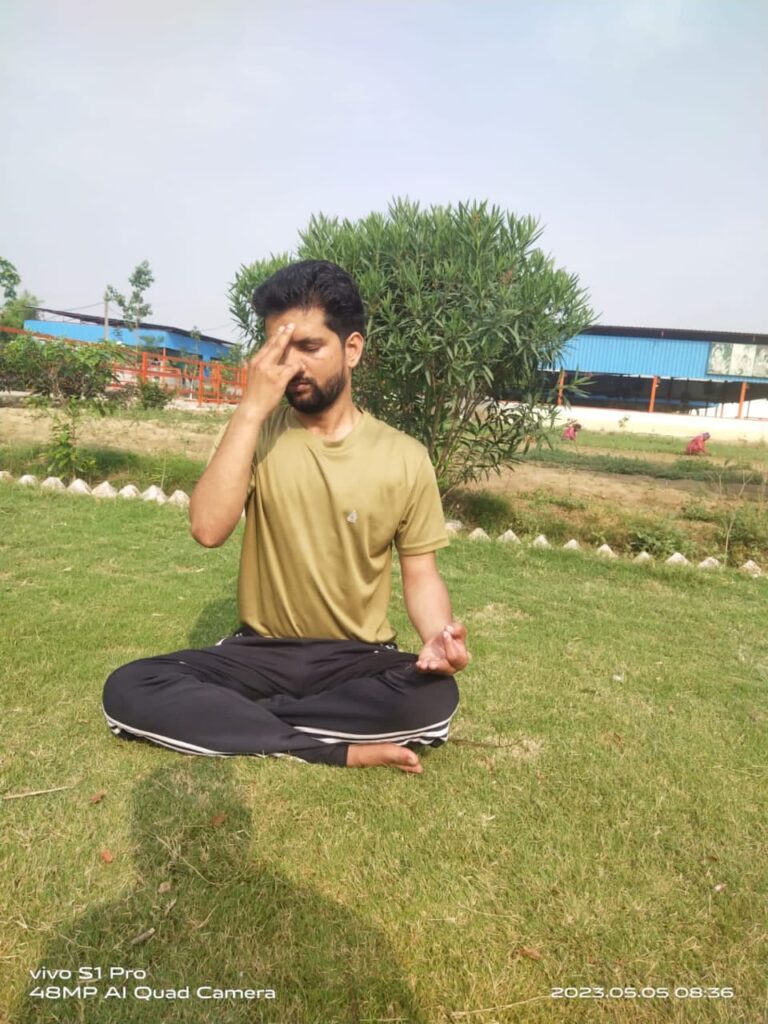
- Place your thumbs on the small cartilage flaps in front of your ears. Beginners can simply rest hands on the knees at first.
- Rest your index fingers lightly on your forehead and the remaining fingers gently over your closed eyes. Do not press. If this feels uncomfortable, skip it.
- Inhale slowly through both nostrils for about 4 seconds.
- Exhale slowly through the nose for 6 to 8 seconds while making a low, steady hum with lips closed.
- Feel the vibration in your face, skull, and chest. Keep the sound even, like a long “mmmm.”
- Pause briefly and return to a normal breath. That is one round.
- Repeat for 5 to 10 rounds.
- Finish by dropping your hands, sitting quietly for a minute, and noticing how your mind feels.
A Sensible Progression
- Week 1 to 2: 5 rounds, 4-second inhale, 6-second exhale
- Week 3 to 4: 8 to 10 rounds, extending the exhale slightly
- Month 2 onward: 5 to 10 minutes daily, with a smooth, quiet hum
- Tip: if you feel any strain, shorten the exhale rather than forcing it
Common Mistakes
Humming too loudly. Loud is not better. A soft, even hum usually gives a better vibration.
Pressing on the ears or eyes. Use a very light touch, or no pressure at all. Hard pressure can cause discomfort.
Forcing a long exhale. Run out of breath and the hum cracks. Choose a length you can finish smoothly.
Breathing through the mouth. The inhale and the exhale both go through the nose.
Tensing the jaw and face. Keep your tongue soft and your lips lightly closed.
Rushing the rounds. Pause between rounds and notice the quiet afterward.
Practicing in a noisy or distracting place. It is harder to follow the sound with your attention.
Who Should Be Careful
Bhramari is gentle, but a few groups should take care:
- Active ear infection or ear pain. Avoid pressing on the ears, and ideally skip the practice until it clears.
- Eye conditions such as glaucoma or recent eye surgery. Do not press on the eyes.
- Pregnancy. The humming breath without any holding is generally gentle, but check with your doctor first.
- Heart conditions or blood pressure problems. Keep it gentle and relaxed, and check with your doctor.
- Epilepsy. Check with your doctor before starting any breathing practice.
- Severe sinus pain or fever. Rest and seek medical advice instead.
Stop if you feel dizzy, lightheaded, unusual pressure in the head, or discomfort in the ears or eyes.
Best Time and How to Fit It Into Your Day
Bhramari can be practiced at almost any time, which is part of its appeal. Early morning is good for clarity, and evening or before bed is good for winding down. Avoid practicing right after a heavy meal.
A simple 15-minute routine:
- 2 minutes of gentle neck and shoulder rolls
- 5 minutes of Anulom Vilom
- 5 minutes of Bhramari
- 3 minutes of silent sitting
If you only have three minutes, do five rounds of Bhramari on its own.
A Few Practical Tips
- Learn from a teacher for a session or two. It is easy to press too hard or hum too loudly.
- Practice daily, even briefly. Short, regular sessions work better than occasional long ones.
- Focus on the vibration, not the sound quality. You are not performing.
- Keep it soft. Soft hum, soft face, soft shoulders.
- Do not chase results. Treat it as a daily reset.
The Bottom Line
Bhramari is not a miracle cure, and it does not need to be. It is a simple, free practice that turns breath into sound and gives the mind something calm to hold on to. The research is encouraging but still limited, and the best results come from gentle, consistent practice done with correct technique.
Start softly, keep the hum smooth, and stop if anything feels wrong. The goal is calm, not volume.